Canonicalize
An agent turns a language or image prompt into a foreground reference and a structured scene specification.
1 Galbot 2 Peking University 3Zhejiang University 4 The University of Hong Kong 5Tsinghua University
CoRL 2026
Abstract
Robot manipulation foundation models require scalable evaluation and data generation across diverse scenarios, with simulation providing an environment for both. Automated scene generation offers a promising path, yet prior work has largely emphasized coarse-grained scene layouts rather than fine-grained functional object compositions.
Motivated by this gap, we present GIF, an agentic Generation framework for Interactive and Functional object compositions. In this framework, we recast this problem as disentangled reconstruction followed by relative pose recovery. CoGen produces instance-disentangled meshes with coarse initial poses leveraging complementary strengths of 2D and 3D generative models. GPRM refines the relative pose under joint geometric and physical guidance, and a VLM verifier selects the candidate that best matches the structured specification. We further construct a benchmark spanning eight representative contact-geometry classes and compare with state-of-the-art generators; GIF improves both asset quality and relation matching, while reducing collision rate to below 1%. Finally, we synthesize data for policy learning, revealing diversity scaling in both simulation and real-world deployment.
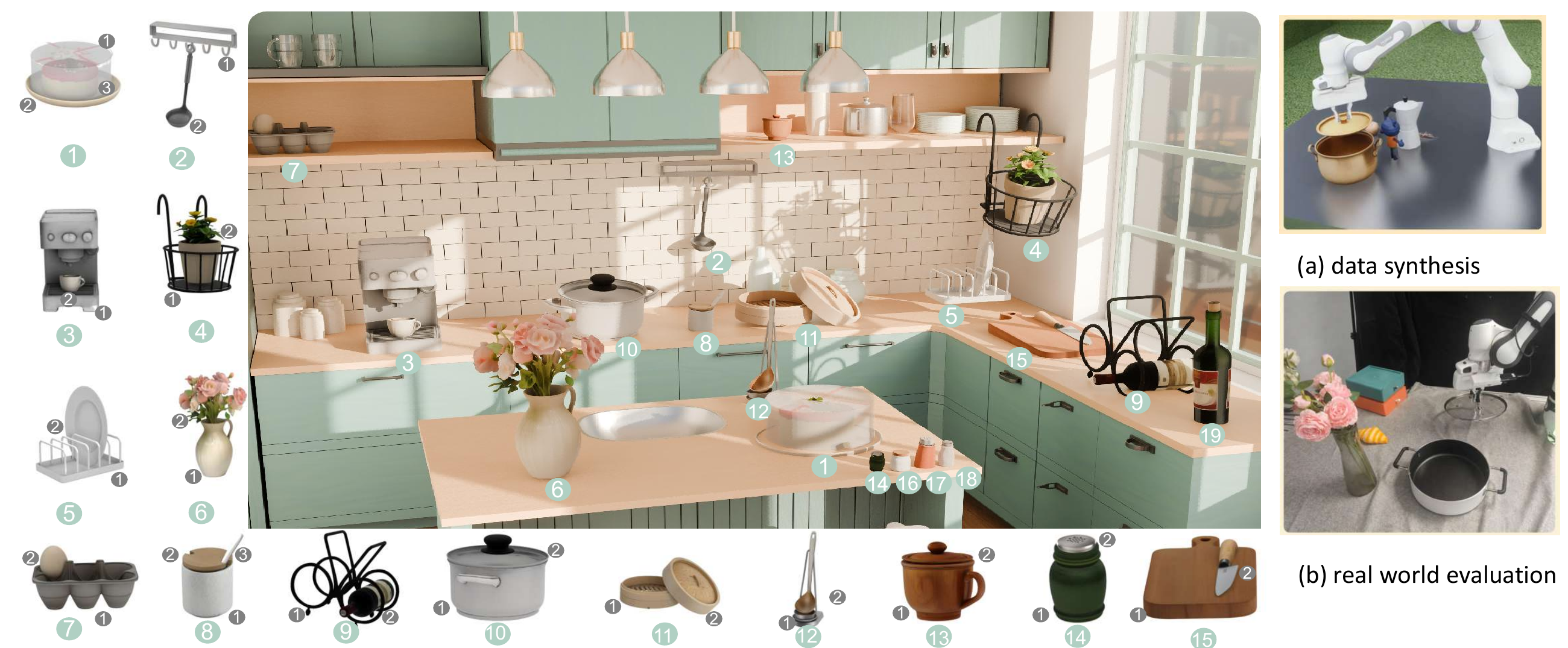
From asset generation to real-robot deployment.
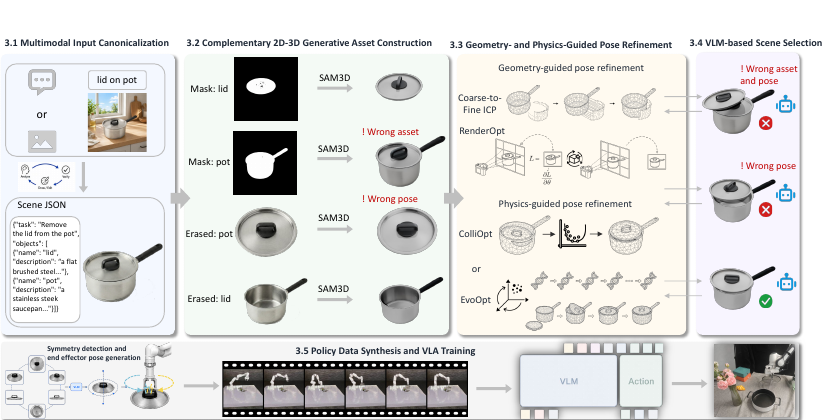
An agent turns a language or image prompt into a foreground reference and a structured scene specification.
Complementary direct reconstruction and erase-and-regenerate branches produce clean, disentangled 3D assets.
Geometry- and physics-guided modules recover contact-precise, collision-free relative poses.
A vision-language verifier inspects simulated rollouts and selects the scene that best matches the specification.
Verified scenes seed diverse trajectories for VLA training and direct real-robot deployment.
8 representative object-interaction relations. 120 scenes.
Grounded in real human manipulation from Ego4D, the benchmark covers 8 representative pairwise contact-geometry relations: containment, capping, resting, leaning, hooking, slotting, spanning, and pegging. Each relation includes 3 manipulation tasks, each with 5 semantic variants: 24 tasks and 120 scenes in total.
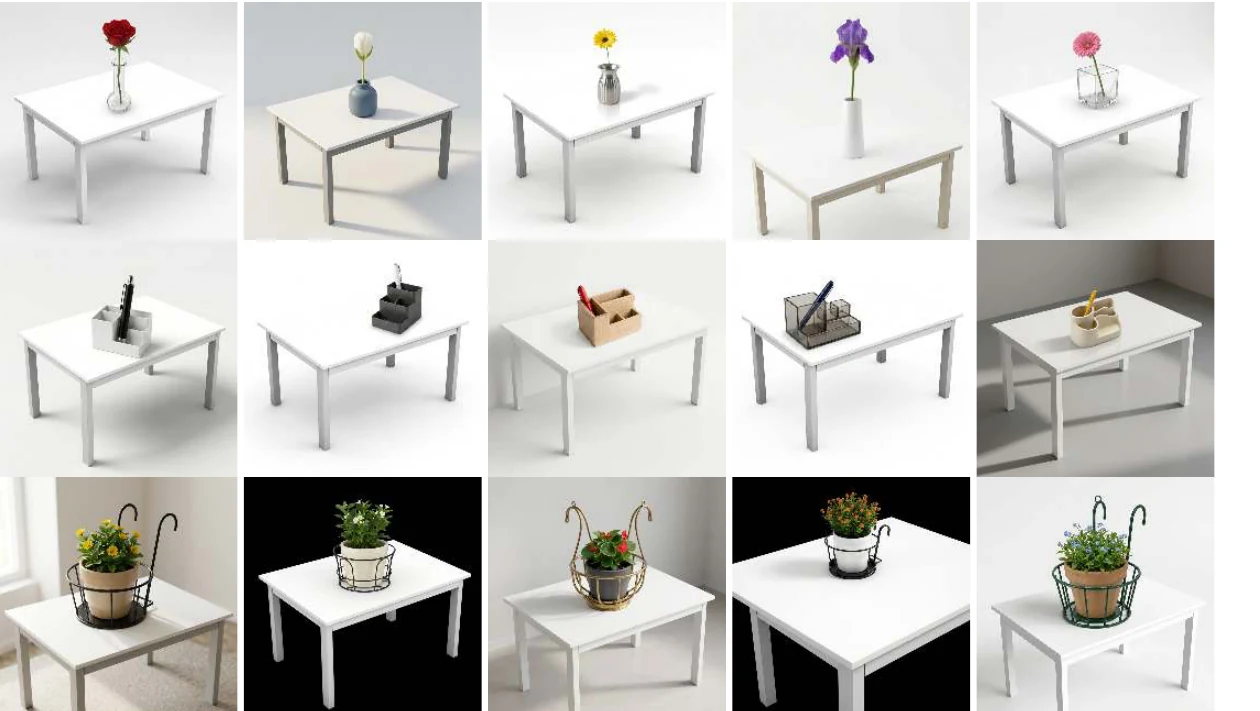
Flower–vase · Pen–organizer · Pot–stand
15 variants ↗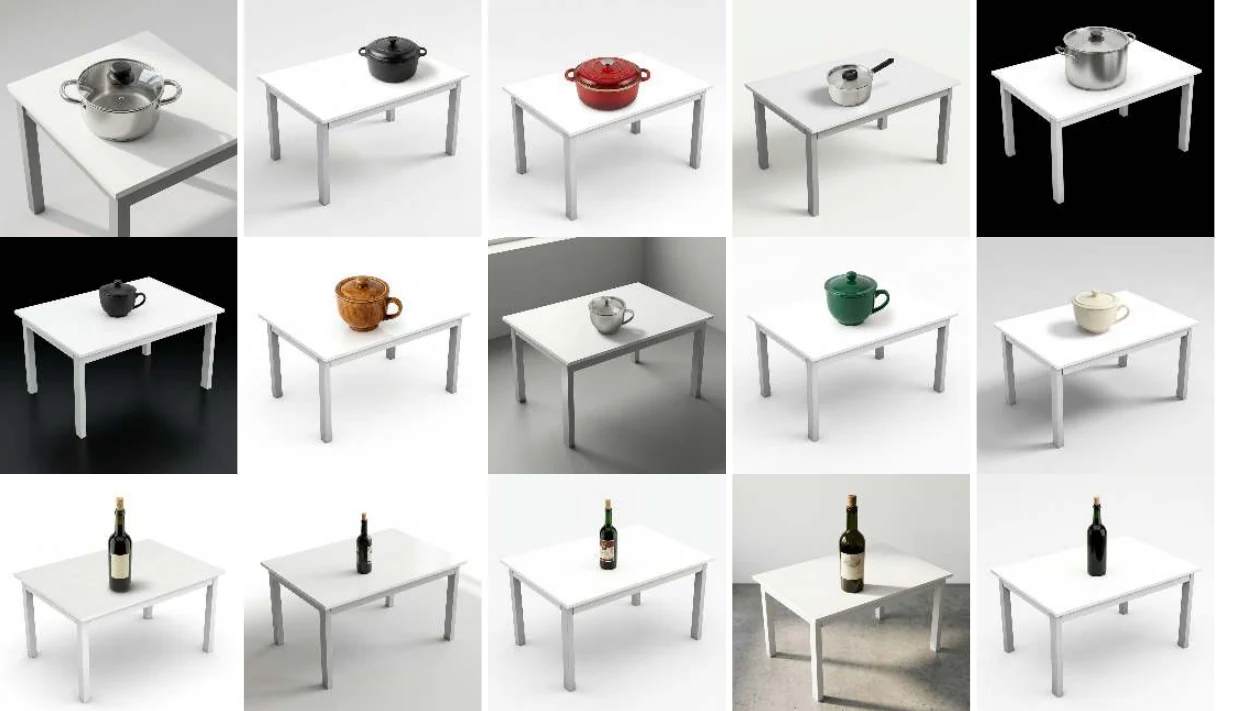
Pot–lid · Teacup–lid · Bottle–cork
15 variants ↗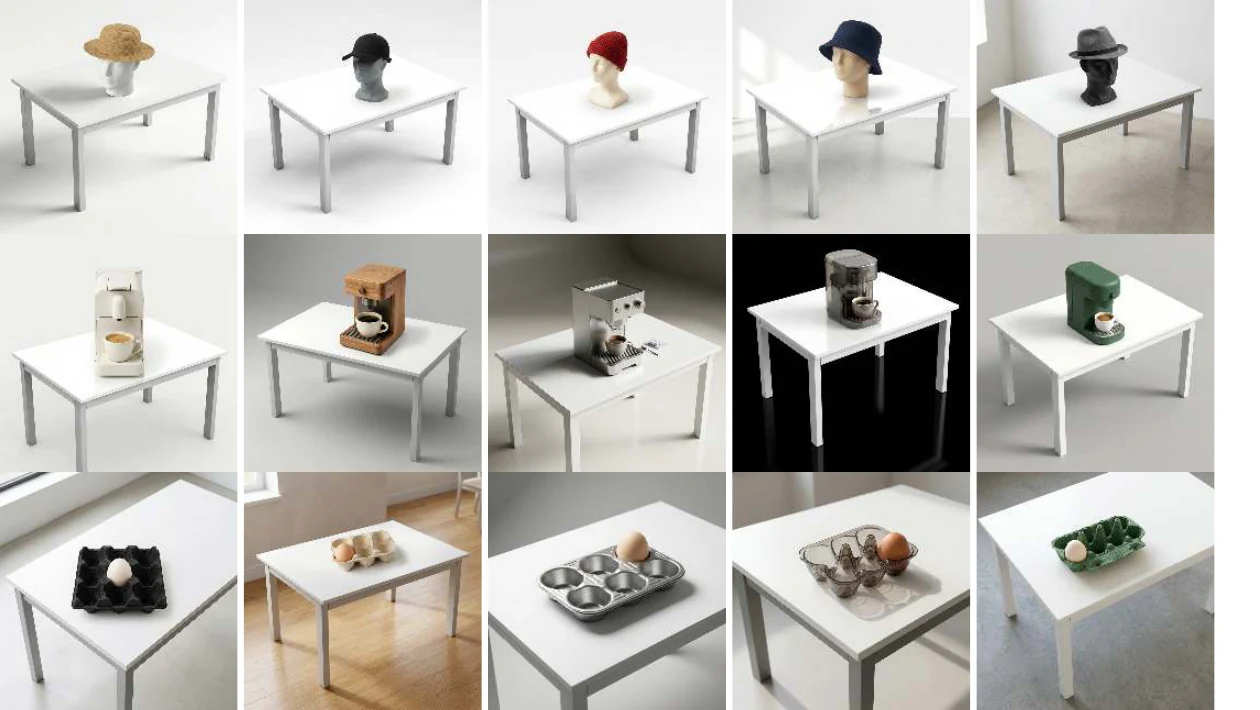
Hat–head · Coffee machine · Egg–carton
15 variants ↗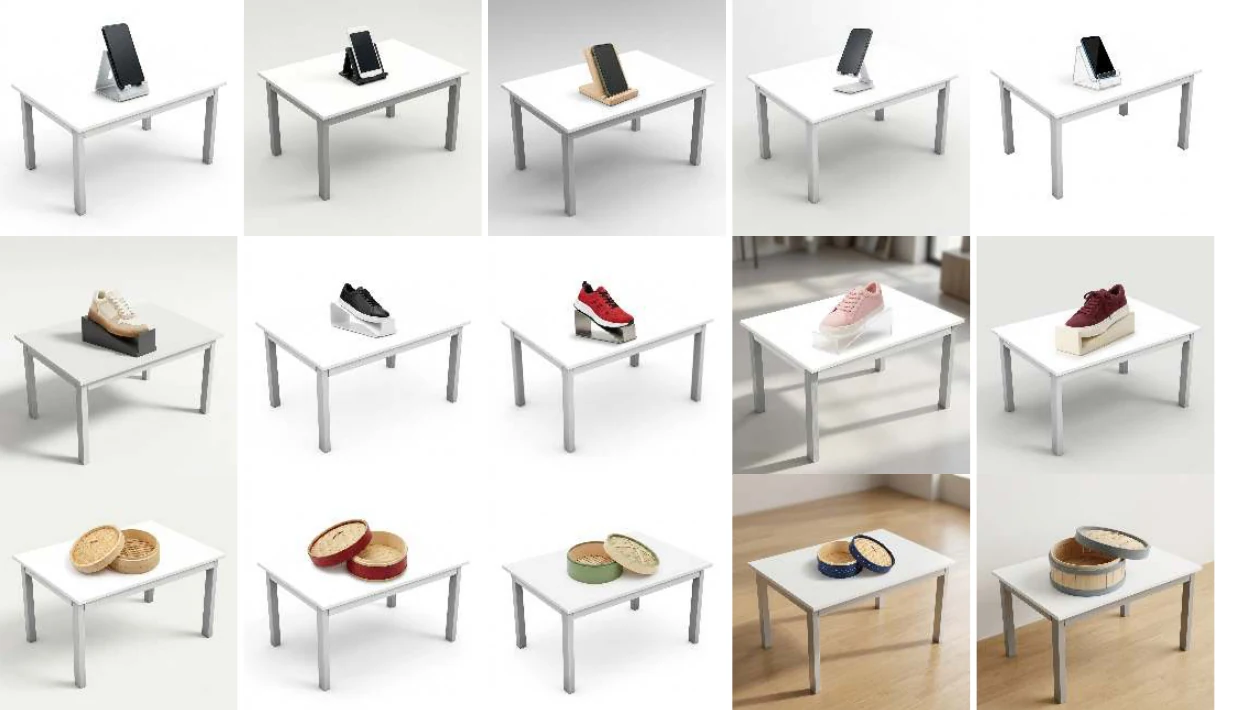
Phone–stand · Shoe–stand · Steamer–lid
15 variants ↗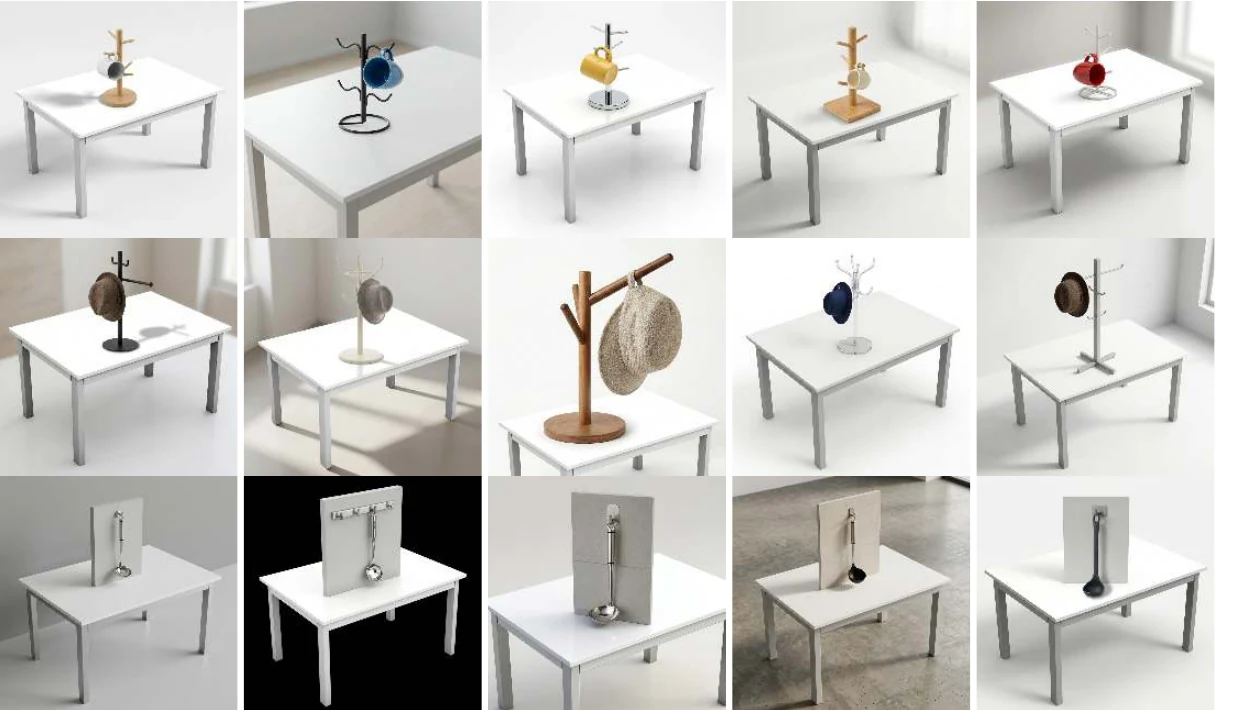
Cup–rack · Hat–rack · Spoon–hook
15 variants ↗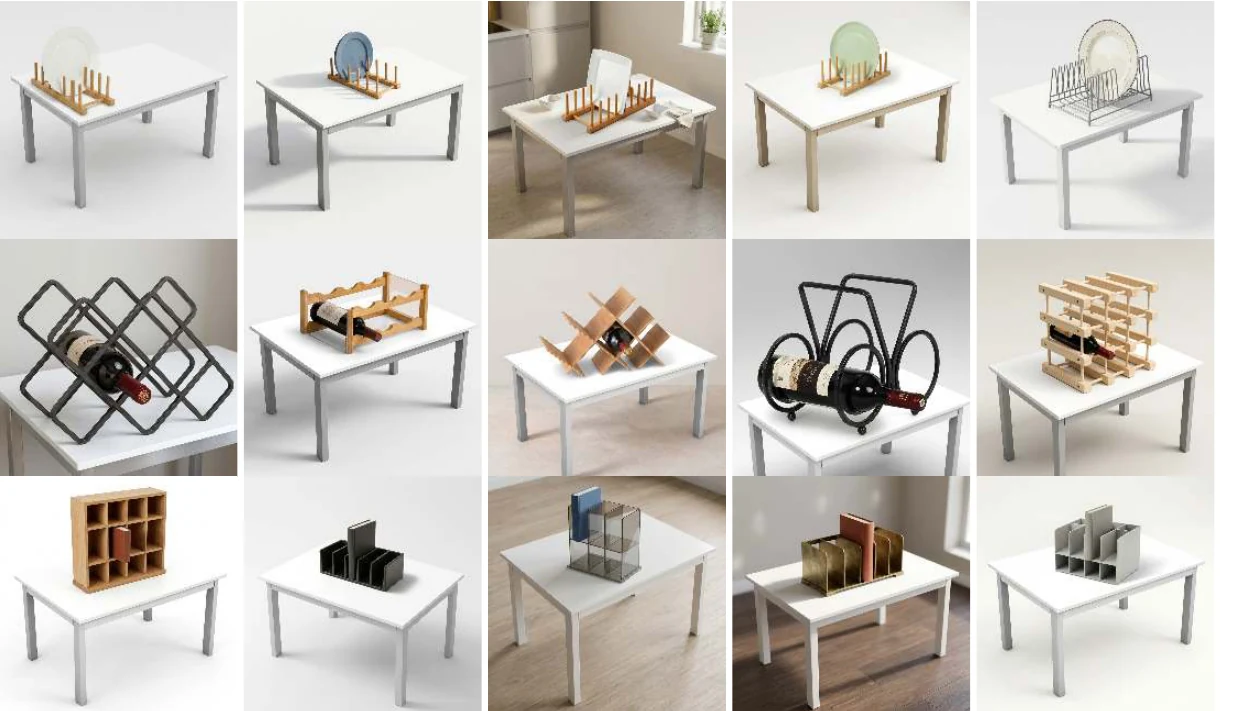
Plate–rack · Bottle–rack · Book–stand
15 variants ↗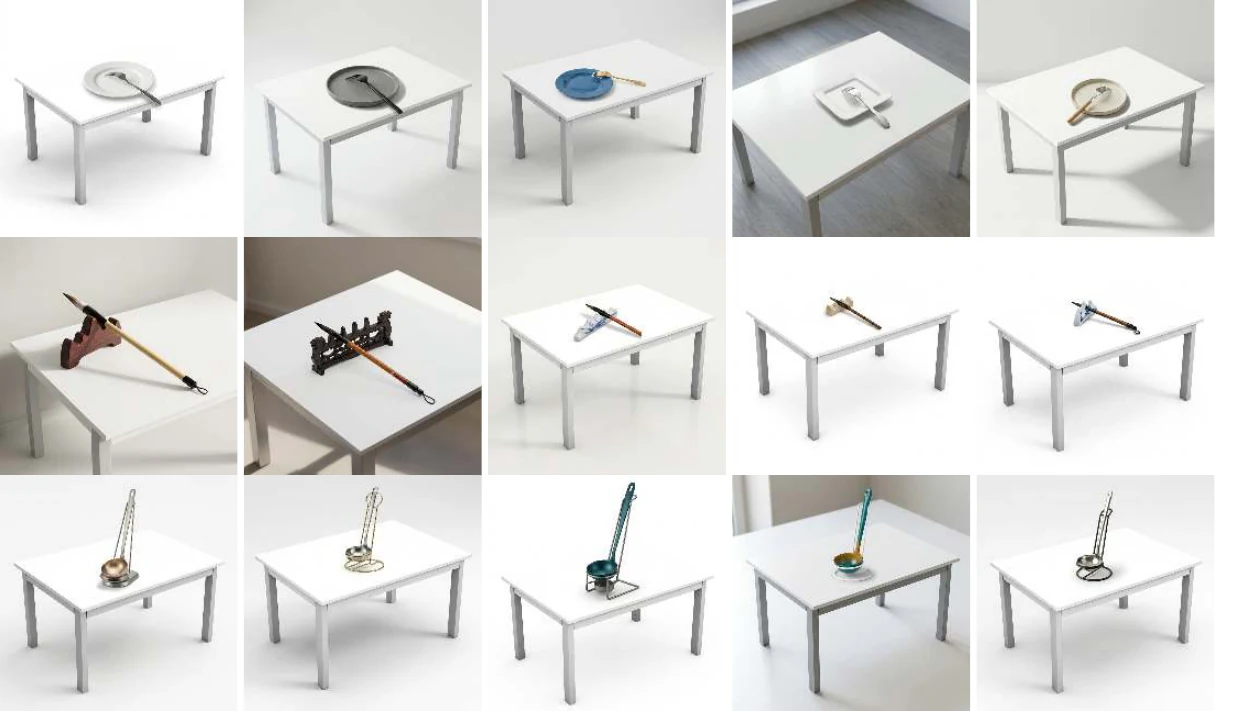
Fork–plate · Brush–stand · Ladle–stand
15 variants ↗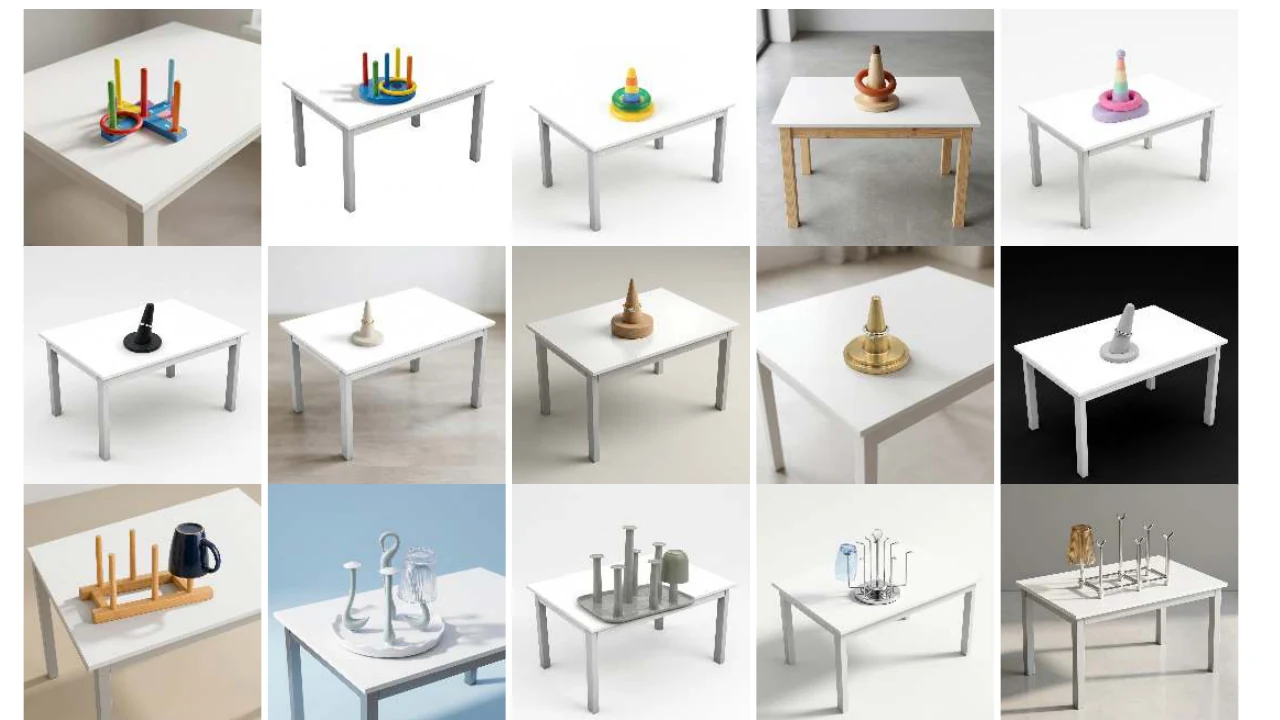
Toss ring · Jewelry holder · Mug–rack
15 variants ↗Trajectory synthesis
The same pipeline scales from a single contact-rich rollout to parallel generation across object identities, appearances, and functional relations.
Real-robot results
GIF turns functional compositions into varied simulation rollouts, then uses the resulting data to train policies that execute the same instruction on physical hardware.
Generated containers and food assets produce varied training rollouts before the learned policy is deployed on hardware.
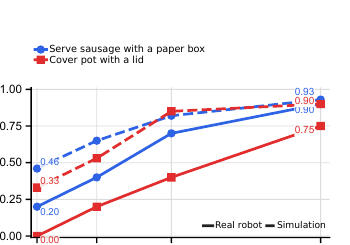
Asset diversity changes the geometry seen in simulation while preserving the same functional relation required by the real task.
The payoff
As the asset budget grows from 2 to 40, both real-world tasks improve monotonically.
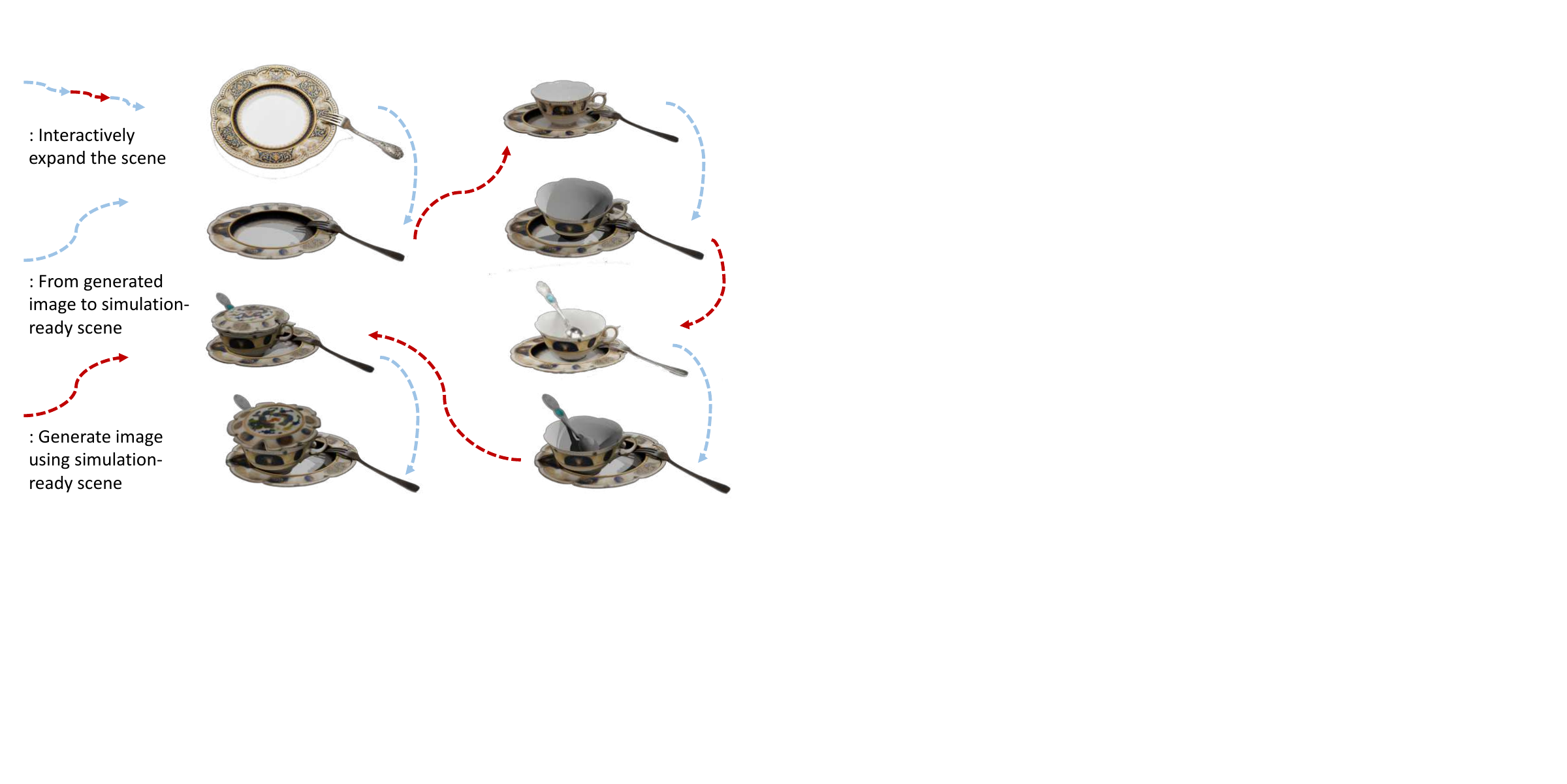
From object pairs to multi-object scenes.
Citation
Accepted at CoRL 2026. Read the manuscript, explore the code, or cite the conference paper.
@inproceedings{xu2026gif,
  title   = {GIF: Agentic Generation of Interactive and
             Functional Object Compositions for Robot Learning},
  author  = {Xu, Long and Zhang, Zhiqi and Yan, Mi and
             Deng, Shengliang and Xia, Chong and Dong, Mingyu and
             Chen, Jiayi and Lyu, Jiangran and Gao, Fei and
             Zhang, Zhizheng and Wang, He},
  booktitle = {Conference on Robot Learning (CoRL)},
  year    = {2026}
}